Robert Kulicke
American, 1924-2007
Robert Kulicke was born in Philadelphia in 1924 and served in the U.S. Army during World War II. After the war, he studied at the École des Beaux-Arts in Paris under the modernist master Fernand Léger, where he developed both technical skills and a lasting appreciation for classical forms. Returning to the United States, Kulicke settled in New York City in 1951 and established a custom framing business that would revolutionize postwar American art presentation.
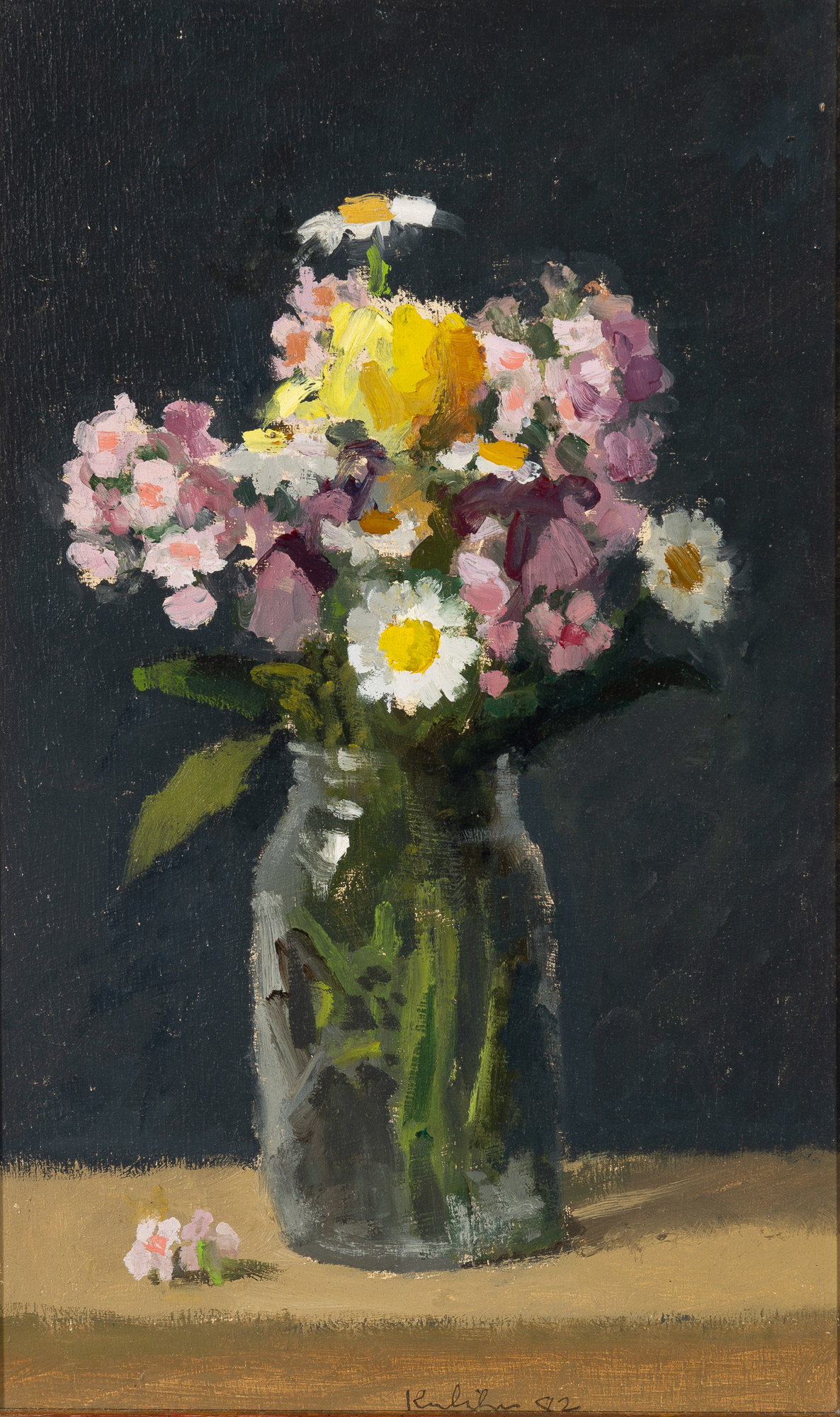
Kulicke's innovative frame designs became synonymous with mid-century modernism. Museums and galleries across the country adopted his minimalist aesthetic, and he framed major works for artists such as Picasso, de Kooning, and Jasper Johns. Despite his success in design, Kulicke maintained that painting was his true calling. His paintings, primarily still lifes of fruit, flowers, and delicate objects, are defined by a quiet elegance. Influenced by artists like Jean Siméon Chardin and Giorgio Morandi, Kulicke worked on a small scale, using jewel-like palettes and classical compositions to evoke a sense of intimacy.
In the late 1960s, Kulicke turned to ancient techniques, reviving goldsmith granulation and co-founding the Kulicke-Stark Academy, which would evolve into the Jewelry Arts Institute. His dedication to craft bridged multiple disciplines, uniting fine art, design, and metalwork into one vision.
Today, Robert Kulicke is remembered not only as a pioneer in modern frame design but also as a painter of remarkable sensitivity. His legacy reflects a lifelong artistic pursuit, questioning how we frame art and preserve the beauty in everyday forms.